
You Should Be Resilient
An Exposition on One of Pythagoras's Golden Verses


"Bear, whatever may strike you, with patience unmurmuring;
To relieve it, so far as you can, is permitted,
But reflect that not much misfortune has Fate given to the good."

-Pythagoras, Golden Verses (Pythagorean Sourcebook and Library, pg. 163)
Wisdom Dealer Note: Welcome to Proverb Peddling. I’m your wisdom dealer [Parker Settecase] and I’m here to help you understand a proverb and a saying, the words of the wise and their riddles in order that you might live a life of wisdom. I have a couple other publications and public philosophy projects but this one is especially special to me. I’m hoping to grow this one more organically on its merits and not based on my name. We’ll see how that goes. But I am burdened to share the wisdom that I collect with others, so this is my attempt at discharging that burden. I will share the wise sayings I’ve found and help you understand them so you can live in light of their truth as well.
If you benefit from this work, please consider becoming a paid subscriber and help me continue it.
Pythagoras is a giant in the history of philosophy—he coined the term! His teachings impacted Plato to such a degree that some scholars call Plato the most famous Pythagorean. He was a philosophical sage, a wizard attributed with performing miracles, and was rumored to be a son of Apollo—or perhaps even Apollo himself in the flesh.
Whatever we think of the mythology of Pythagoras the golden-thighed sage, his influence on western thought is unassailable. There is no Plato without Pythagoras and there is no West without Plato.
The Golden Verses of Pythagoras are said to be something of an epitome of the philosophy of Pythagoras. An epitome, in ancient philosophical sense, was a concise summary of a philosopher’s teachings, often created by disciples in order to share the wisdom of their sage with others.
The Golden Verses, however, are more of an epitome of Pythagoras’s practical philosophy—how one should live and act in order to live the good life—rather than an epitome of his philosophy simpliciter (in general). Pythagoras had a whole ton to say about just about everything, yes how one ought to live, but also about the nature of reality, the ontological status of numbers, sacred geometry, the gods and wizardry, musicology, and much more theoretical or speculative philosophy.
The Golden Verses do touch on various aspects of the speculative philosophy of Pythagoras because to Pythagoras and the other ancient sages, practical and theoretical philosophy must go hand in hand—the nature of reality ought to inform you as to the best way to live in it. But the emphasis of the Golden Verses is more on how to live than where we live.
Bear, whatever may strike you, with patience unmurmuring; to relieve it, so far as you can, is permitted, but reflect that not much misfortune has Fate given to the good.
-Pythagoras, Golden Verses (Pythagorean Sourcebook and Library, pg. 163)
So, what are we to take from this pericope? How is this sententia (wise saying) meant to help us live well?
Pythagoras’s teaching is something of a proto-Stoic encouragement. Face whatever hardships befall you, physical or otherwise, with endurance. Be patient with yourself and in the trials you’re facing. Why? Because the more you stress out about your trials, the worse your situation become.
You may literally make your external circumstances worse by panicking and brashly thrashing about to free yourself in impatience. But even if not, you’ll certainly make your internal circumstances, your thought-life and emotions, much more tumultuous by giving in to an impatient and hysterical attitude.
Bear it. Bear it with patience. Don’t grumble about your life, don’t actively view yourself as a victim. That way lies turmoil, isolation, and the locked-in desparation of panic.
Bear whatever may strike you with fortitude and endurance. This season will pass—and even if it doesn’t, I refuse to let my trials defeat me. I won’t let that which strikes me master me and turn me into a murmuring victim.
That doesn’t mean you can’t seek to relieve your stress, your pain, your trials. To relieve it, so far as you can, is permitted. This isn’t full-blown Stoicism where the external world is thought to be beyond your control. Act to change your circumstances. But when doing so, don’t make your life worse by giving into whining and comparison, envy and lamentation for one’s own self.
Reflect that not much misfortune is given to the good by Fate. What’s this mean? Well, it could be several things. If you believe this sententia, whether you believe it’s Fate at the helm or God, then you have two options to consider: am I ‘good’ or not? If so, then I can endure the hardships that strike me with hope because I believe this season will pass. If not, if you aren’t all that good, then you can have hope that by changing your actions, intentions, emotions, pro-attitudes (desires, approvals, preferences, likings, etc.), then perhaps you’ll can find relief from the hardships which you’ve earned from fate or God.
For the Christian, you will hold onto verses like Romans 5:3-5 and 8:28 where it’s promised that all things work together for your good, to make you more resilient, virtuous, Christ-like, and hopeful.
Whatever the case, the worse things to do when trials and tribulations strike you is to panic in impatience, rage internally, and murmur and complain to those around you, seeking pity and victimhood status.
Stand up from underneath your trials and bear them with endurance. This is the good path—or so says Pythagoras the Sage.

Proverb Peddling Zine
If you enjoyed this commentary on the Golden Verse, you’ll love Proverb Peddling the magazine (zine). Grab issue 1 below:
You could also grab a copy from my Shopify shop if you prefer that to Etsy:
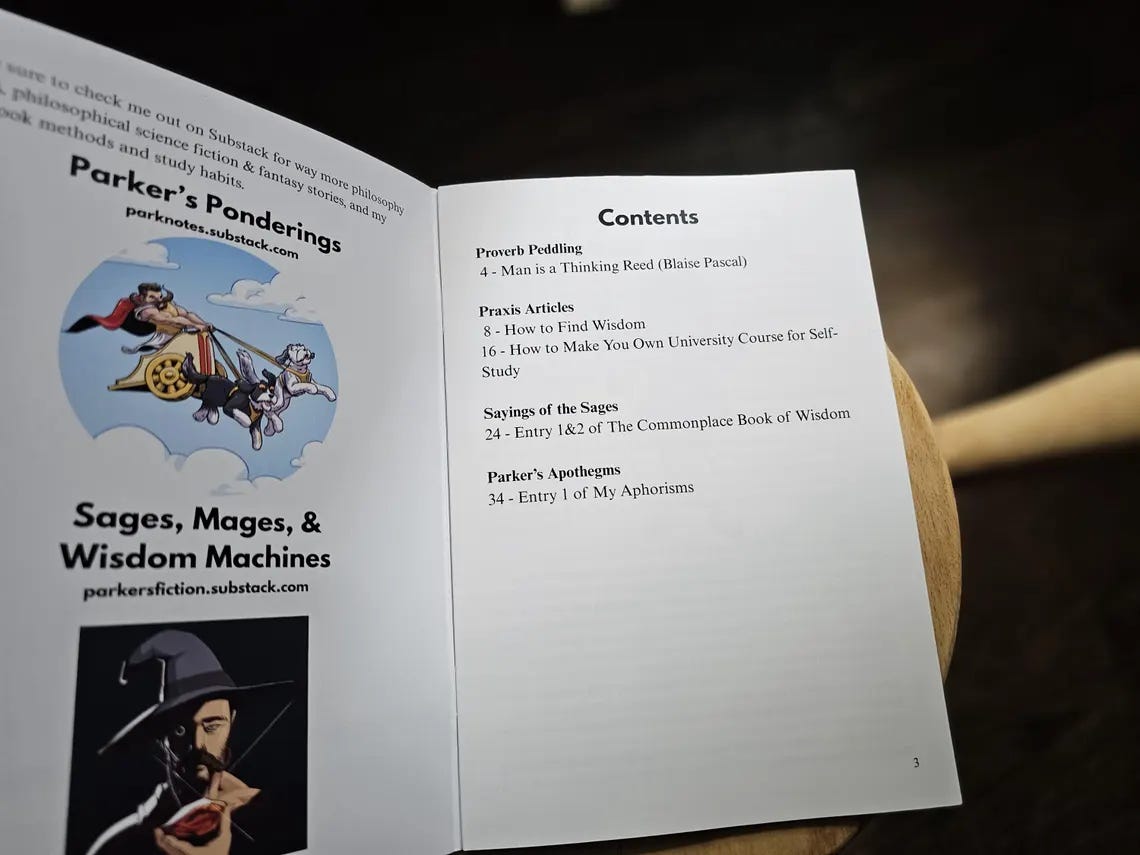
Quality peddled wisdom!!
Parker, it’s been 40 years since my last philosophy course “Theories of Rhetoric”, taught using the Socratic method by a professor that I deemed half madman / half genius. Looking forward to learning more from you. Thanks!